The opening
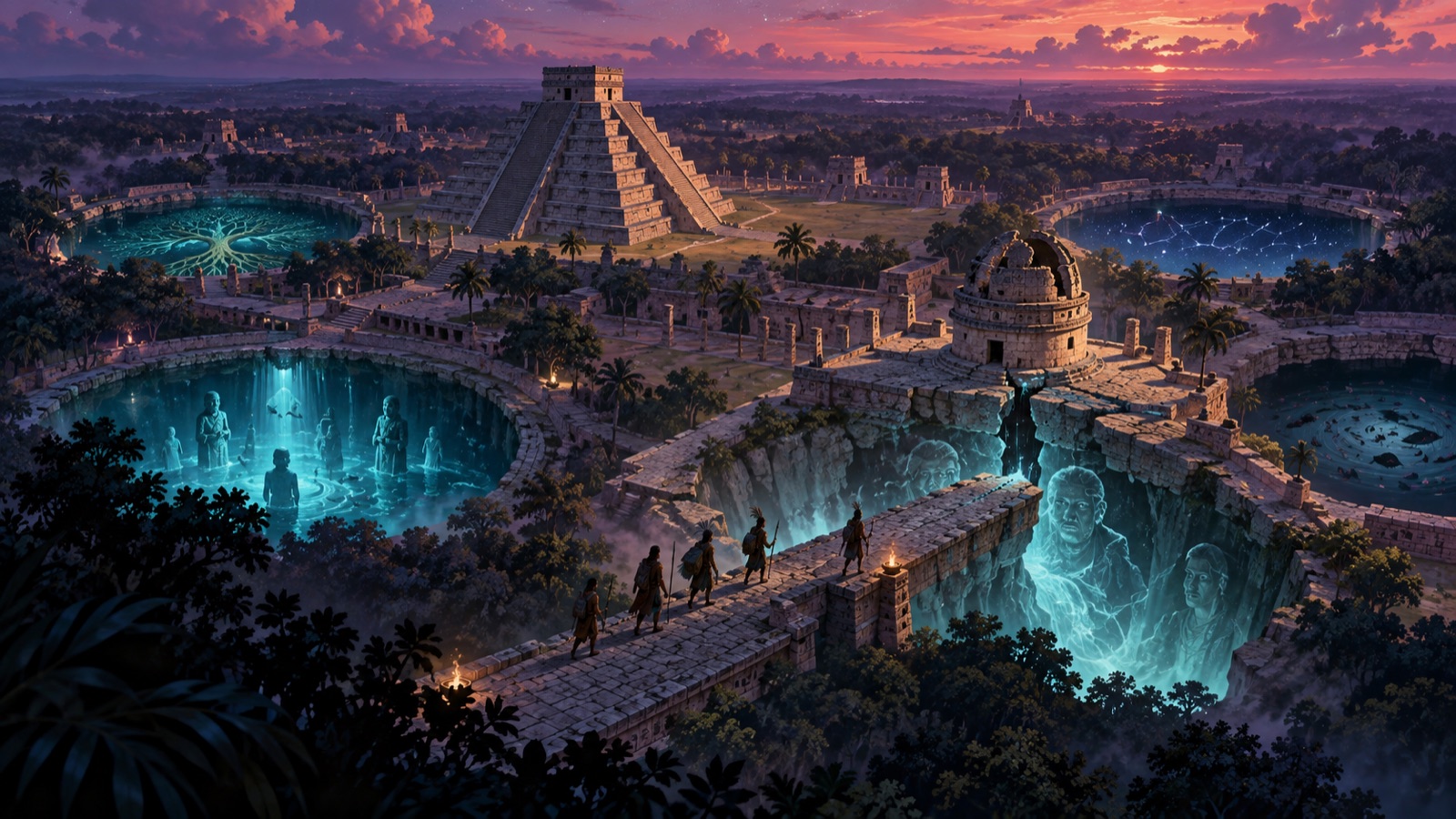
The characters arrive for the equinox, when the sun casts a serpent down the steps of El Castillo. Their guide calls himself Kukul and promises a view away from the crowds. The shadow reaches the ground, turns its head, and slips toward a cenote.
That evening a tourist van is found empty beside the water. Kukul leads the party through a restricted path to search for the missing group. He knows the names of offerings recovered decades ago and becomes stronger whenever the serpent shadow passes over him.
What the party is trying to do
Find the missing visitors, uncover what the equinox shadow awakened, and return before the cenote closes.
A route through the campaign
- Descend through a cenote cave where reflections show the city at different moments in history.
- Find the missing tourists alive in a ceremonial court that no longer exists on the surface.
- Follow Kukul through four chambers tied to water, memory, possibility, and forgetting.
- Discover that he arranged the private tour and needed outsiders to open the final well.
- Face Kukul as feathers cover his skin and he names himself Kukulkan.
Possible endings
- Defeat Kukulkan and close the fourth well before forgotten history overwhelms the present.
- Open all four wells and help the returned people claim a place in the modern world.
- Write a new covenant that restores the water system while limiting the god's reach.
History and invention
Chichen Itza developed near natural water filled cavities called cenotes. Its surviving buildings include El Castillo, the Great Ball Court, the Temple of the Warriors, and the circular Caracol observatory. The four supernatural wells and their shared mechanism are original fantasy.
Content notes: drought, threatened sacrifice, disputed ancestry.
We played a tabletop RPG adventure in Chichén Itzá last year, and the place did half the storytelling for us. This outline understands that.
I would ask each player what their character believes about cultural exchange before session one.
The best part of The City at the Four Wells is that the antagonist can be right about one important thing and still be impossible to support.
water and authority is such a strong pressure point for this story.
The second campaign beat in The City at the Four Wells is the one I would build the trailer around: Find the missing tourists alive in a ceremonial court that no longer exists on the surface.
Saving The City at the Four Wells for our next campaign.
That Chichén Itzá backdrop is doing real work here. It does not feel pasted onto a generic dungeon.
I would keep the real history notes for after each The City at the Four Wells session. My players love checking what was true once the spoilers no longer matter.
The job in The City at the Four Wells is to find the missing visitors, uncover what the equinox shadow awakened, and return before the cenote closes. There is a nasty moral problem inside that objective.
Session zero for The City at the Four Wells: ask everyone what their character would never trade for safety. Then bring those answers back near the ending.
The 6 to 10 sessions length feels right for The City at the Four Wells. Enough room to build suspicion without losing the thread.
I ran something adjacent to The City at the Four Wells, but the party trusted the wrong faction almost immediately. I would keep that possibility open here too.
I would open The City at the Four Wells right in Chichén Itzá and let the party find the first clue before anyone explains it.
I can already hear my group arguing over whether to defeat kukulkan and close the fourth well before forgotten history overwhelms the present.
The City at the Four Wells feels playable rather than merely clever. I know what the party is doing, what can go wrong, and where I can improvise.
I would move the reveal in The City at the Four Wells one session earlier and let the players spend longer deciding what to do with it.
The choice to open all four wells and help the returned people claim a place in the modern world would absolutely split my table. Perfect.
The part where the party must descend through a cenote cave where reflections show the city at different moments in history gave me the whole first session.
I would give the first clue in The City at the Four Wells to the least scholarly character. It keeps the mystery from becoming one person reading while everyone waits.
My players would turn the first choice in The City at the Four Wells into a three hour argument. I mean that as praise.
This would work nicely as a DND campaign for players who enjoy investigation but still want a clear objective. The City at the Four Wells gives them both.
The jungle mystery mood in The City at the Four Wells is exactly what my group likes.
My version of The City at the Four Wells would lean harder into competing histories.
One change I might make to The City at the Four Wells: let the helpful NPC save somebody early. The later betrayal hurts more when the kindness was real.