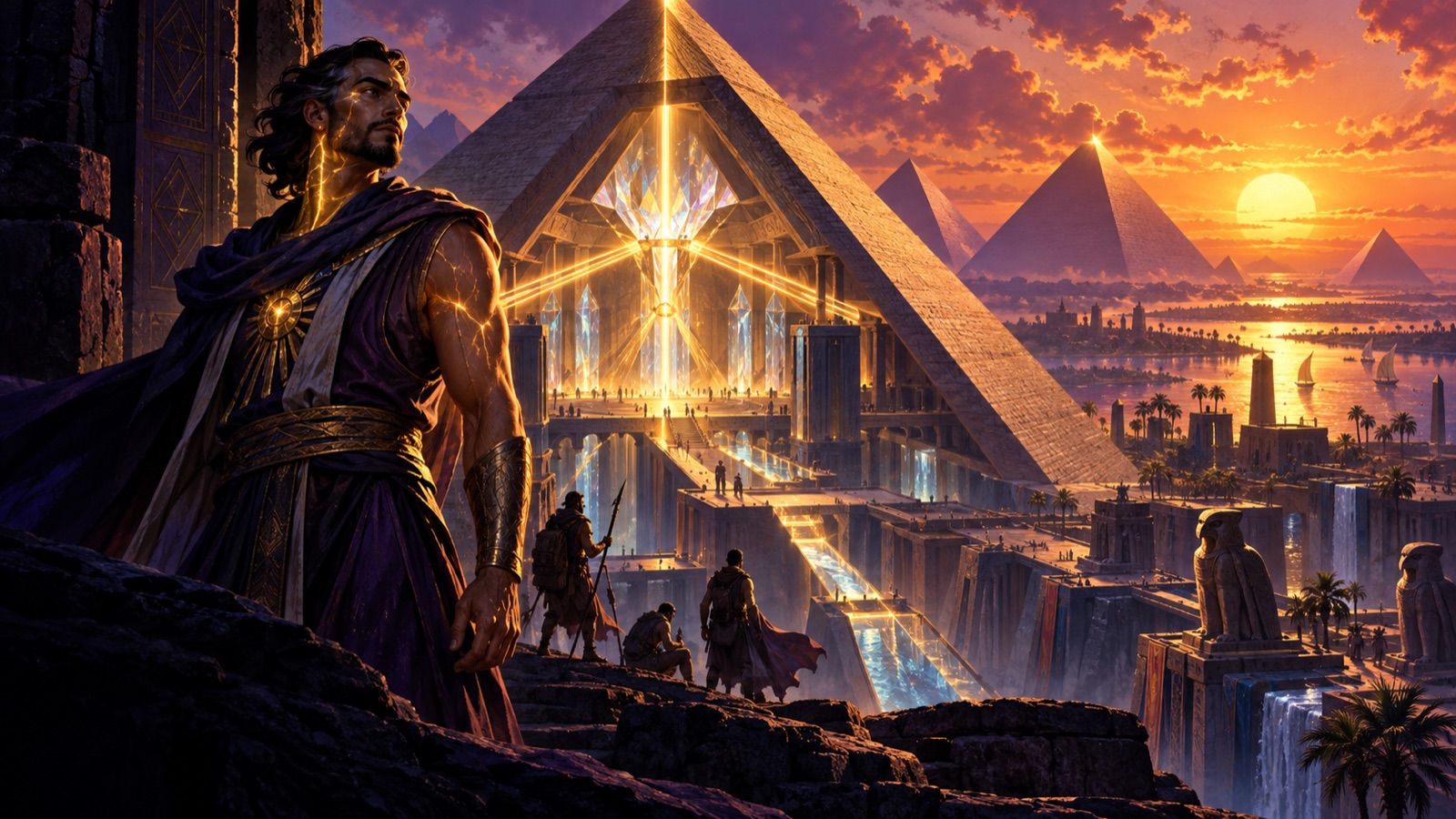
The opening
A collector hires the characters to recover a brass lens found in a newly mapped shaft beneath Giza. Their guide is Razul, a charming engineer who knows the pyramid passages better than the survey team that opened them. He claims the lens belongs to a workshop older than the dynasties that built the tombs.
The deeper chambers look less like burial rooms and more like a power station. Mirrors follow the sun without moving. Copper veins hum inside the stone. Razul always knows which floor will heat up next, and every door opens when his shadow touches it.
What the party is trying to do
Recover the missing lens, identify the builders of the underground machinery, and escape before the solar chambers reach full power.
A route through the campaign
- Cross a mirror shaft where concentrated sunlight forms bridges for a few seconds at a time.
- Find records showing that early Egyptian conquerors inherited the pyramids and later turned them into royal tombs.
- Catch Razul speaking an extinct technical language to a sealed door, then watch him dismiss it as a lucky guess.
- Retrieve the brass lens and see an image of Razul wearing the same face thousands of years earlier.
- Reach the solar heart as Razul seals the exits and the pyramid begins drawing power from the midday sun.
Possible endings
- Destroy Ra's solar body and release the stolen knowledge to the places it came from.
- Trap Ra inside the pyramid and keep the solar network under mortal control.
- Shut the entire system down, leaving the truth buried with the technology.
History and invention
Ra was one of ancient Egypt's principal solar deities, and the pyramids were Egyptian royal funerary monuments. This adventure is deliberate alternative history. Its older civilization, scientific Ra, solar cells, conquest, and artificial body are fictional changes made for the game.
Content notes: famine, colonial violence, body replacement.
The part where the party must cross a mirror shaft where concentrated sunlight forms bridges for a few seconds at a time gave me the whole first session.
I would give the first clue in Ra Beneath the Pyramids to the least scholarly character. It keeps the mystery from becoming one person reading while everyone waits.
My players would turn the first choice in Ra Beneath the Pyramids into a three hour argument. I mean that as praise.
This would work nicely as a DND campaign for players who enjoy investigation but still want a clear objective. Ra Beneath the Pyramids gives them both.
The desert mystery mood in Ra Beneath the Pyramids is exactly what my group likes.
My version of Ra Beneath the Pyramids would lean harder into manufactured divinity.
One change I might make to Ra Beneath the Pyramids: let the helpful NPC save somebody early. The later betrayal hurts more when the kindness was real.
For a D&D campaign idea, Ra Beneath the Pyramids leaves a surprising amount of room for the party to wreck the plan in a useful way.
We played a tabletop RPG adventure in Ancient Egypt last year, and the place did half the storytelling for us. This outline understands that.
I would ask each player what their character believes about stolen knowledge before session one.
The best part of Ra Beneath the Pyramids is that the antagonist can be right about one important thing and still be impossible to support.
technological dependence is such a strong pressure point for this story.
The second campaign beat in Ra Beneath the Pyramids is the one I would build the trailer around: Find records showing that early Egyptian conquerors inherited the pyramids and later turned them into royal tombs.
Saving Ra Beneath the Pyramids for our next campaign.
That Ancient Egypt backdrop is doing real work here. It does not feel pasted onto a generic dungeon.